Democrats swept the midterms across Oregon on November 3. Republicans lost seats. In the eighteen days since, at least eight government agencies and public bodies have gone public with funding gaps, deficits, or new tax ideas. At least five Democratic officeholders and officeholders-elect have joined them.
Then, on November 18, the state's economists delivered a forecast that should have changed the conversation. It didn't.
The number they'd rather you didn't see
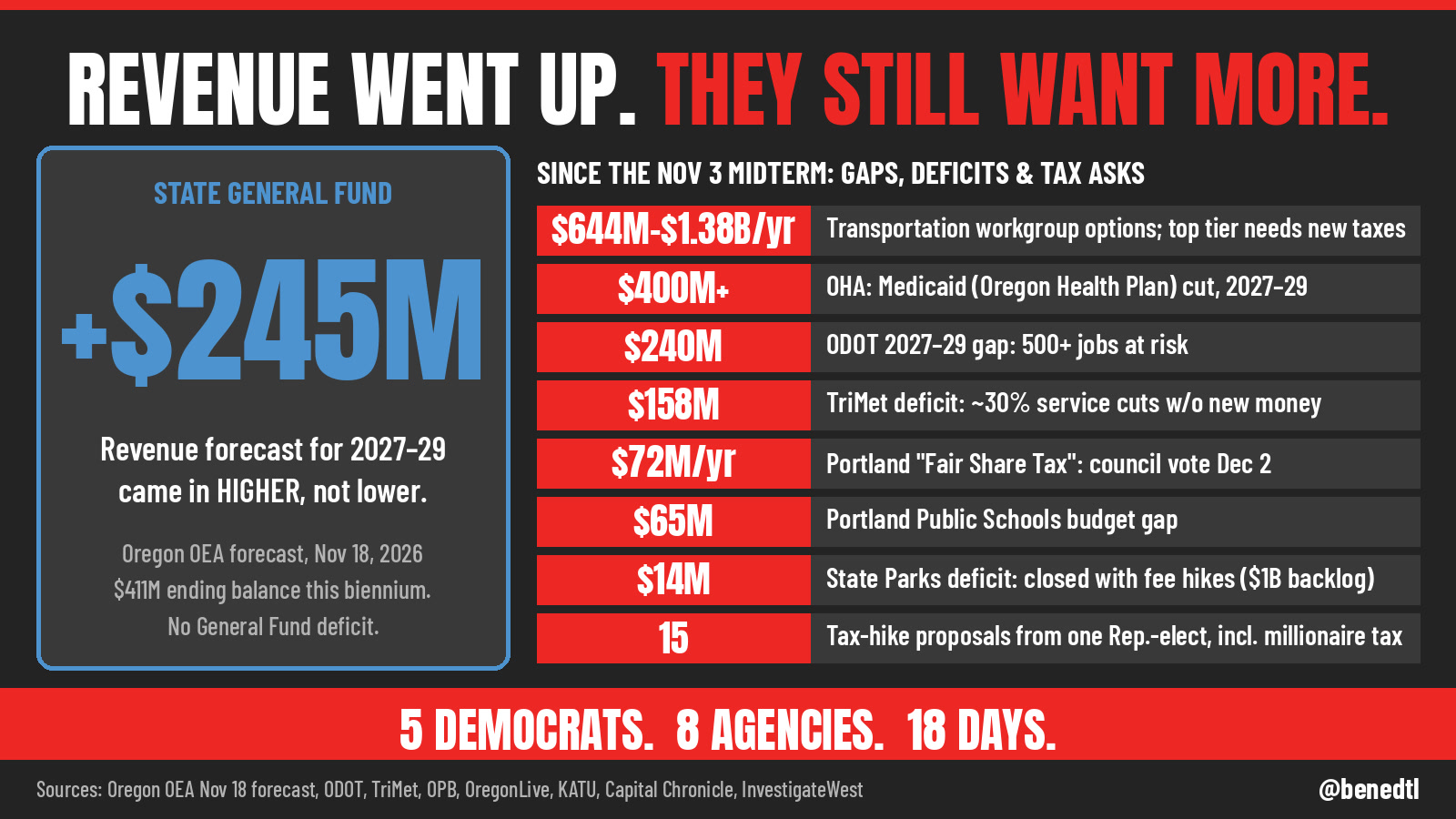
The Office of Economic Analysis told lawmakers that the General Fund forecast for the 2027–29 budget came in about $233 million to $245 million higher than the previous forecast. The current budget is not in deficit either. It is projected to end with a $411 million balance. Governor Kotek herself described the state's position as "steady financial footing."
That's the real slap in the face. The core budget grew. Yet the same week, the message from the agencies running Oregon's roads, transit, health care, and schools was the same one we always hear: we're short, and you'll have to pay more.
The named shortfalls
These are the four largest hard shortfall numbers that public agencies have put on the record since the election. Every figure is sourced.
| Agency | Shortfall claimed | Period | Source |
|---|---|---|---|
| ODOT (operations) | $240 million | 2027–29 budget | ODOT, Nov. 18 |
| Oregon Health Authority (Medicaid) | $421 million | 2027–29 budget | Advisory Group report; InvestigateWest, Nov. 19 |
| TriMet | $158 million | Deficit target through mid-2029 | TriMet board, Nov. 11 |
| Portland Public Schools | $65 million | 2027–28 school year | OPB, Nov. 14 |
| Named shortfalls | ≈ $884 million | ||
| General Fund forecast, 2027–29 | Up ≈ $245 million | vs. prior forecast | OEA, Nov. 18 |
The shortfalls cover different periods and different funds. The total shows the scale of what's being claimed, not a single bill.
That's nearly $900 million in shortfall claims in under three weeks. And it isn't the whole ask. Governor Kotek's transportation workgroup has handed lawmakers a menu of options ranging from about $644 million to $1.38 billion a year. Lawmakers would have to explore new taxes to reach the top option. When Kotek's transportation advisor was asked why the governor wasn't recommending new taxes, she said not to "conflate that with an endorsement from her of taking no action."
Meanwhile, one incoming Democratic legislator has already filed fifteen proposals to raise revenue, including higher income-tax rates, a higher corporate minimum tax, and a tax on millionaires. In Portland, two city councilors are pushing a roughly $72 million-a-year "Fair Share Tax," with a vote set for December 2.
All of this comes six months after Oregon voters rejected the 2025 gas-tax, payroll-tax, and vehicle-fee hikes by more than 80 percent. The voters gave their answer. The machine is preparing to ask again.
A management problem, not a revenue problem
The defenders of this system will say the General Fund and the highway fund are separate accounts, and that's true. It is also the point.
The money Oregon's political class controls most directly is growing. The holes are in the systems it has run for years: roads, transit, Medicaid, and Portland's schools. All of them operate under a Salem that one party has controlled for years, and all of them come back with the same promise: the next tax will finally fix it. More revenue and worse results is not bad luck. It is a management record.
Medicaid shows it most clearly.
Look closely at the Medicaid hole
Salem's story is that Washington caused the $421 million Medicaid gap. Federal changes did trigger it. But in a September 11 letter to lawmakers, the Oregon Health Authority said the majority of the gap comes from changes to provider taxes and state-directed payments. In OHA's own words: "While state directed payments are not federally required, they are required under Oregon laws."
Kotek's own Medicaid advisory group put it plainly: Oregon Health Plan enrollment "has more than doubled in past 10 years," and the benefit package is "relatively rich compared to other states." That growth was built on federal-match financing. When the match changed, the structure cracked.
The waste is documented too, by the state's own auditors:
- In 2017, the Secretary of State's auditors estimated $88 million spent on ineligible enrollees in six months.
- A 2024 audit found Oregon paid about $445 million for people enrolled in Oregon and another state at the same time from 2019 to 2022. Auditors said "a large portion" were improper payments.
- A September 2026 audit found duplicate Medicaid IDs that led to duplicate payments.
- As of January 2026, Oregon still did not regularly check the Social Security death file. Thirty states do.
Now look at what OHA's November 9 draft plan proposes to cut. It would narrow coverage for young adults ages 19 to 21 with special health care needs. It would end home-modification and extreme-weather help that more than 7,400 Oregonians use.
Here's what wasn't on the governor's advisory group's list of more than forty cost options: Healthier Oregon. That's the roughly $1.5 billion program for 2025–27, 87 percent state money, that covers about 94,000 people regardless of immigration status. California and Washington have paused new enrollment in similar programs. Oregon has not.
Put simply, they would rather protect $1.5 billion in health care for noncitizens than disabled Oregonians. And their solution to the gap is to tax the rest of us harder.
The question nobody in Salem wants asked
So here is the question. They can't run a basic budget. Yet somehow they can't lose an election either.
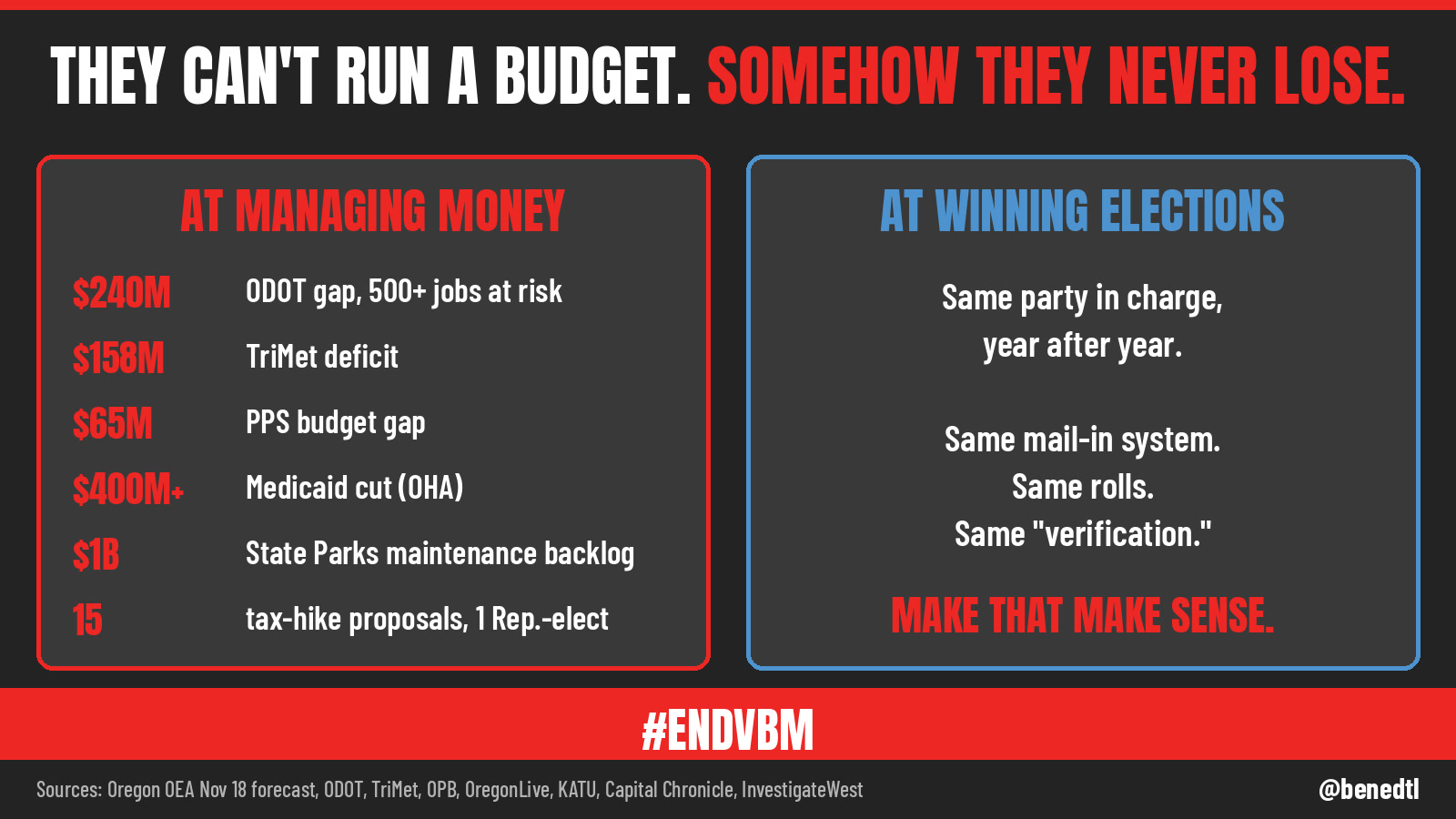
In any other field, a record like this ends careers. A company that ran its divisions this way would face its board, its shareholders, and its competitors. In Oregon, the same party runs the same agencies, writes the same tax proposals, and wins again.
You don't have to prove a single race was stolen to see the problem. Oregon runs its elections on universal vote-by-mail, and the accuracy of its rolls and its signature verification are questions Salem would rather not discuss. In 2025, a referral to restore in-person Election Day voting died in committee. When those who fail at governing never face a real consequence at the ballot box, the system that counts the ballots deserves hard scrutiny. Citizens tried to put in-person voting before voters with Initiative Petition 37. It had to fight on its own, and it didn't qualify.
One-party rule doesn't just produce bad budgets. It removes the one thing that forces anyone to fix them: the real chance of losing.
What we do about it
Complaining about the next tax is not a plan. Building the power to stop it is.
That starts with a ballot Oregonians can trust and a party structure strong enough to fight for it. Oregon's precinct committeepersons are the elected base of that structure. They choose the leaders, recruit the candidates, and decide whether the party fights or folds. Every empty seat is a vote someone else casts for you.
Fill them. Fight for elections we can verify. Hold those who run these agencies to the standard every business owner already lives by: deliver results or lose your job.
The governor's budget lands December 1. Portland votes on its tax December 2. The 2027 session is coming. They already have their list. It's time we had ours.